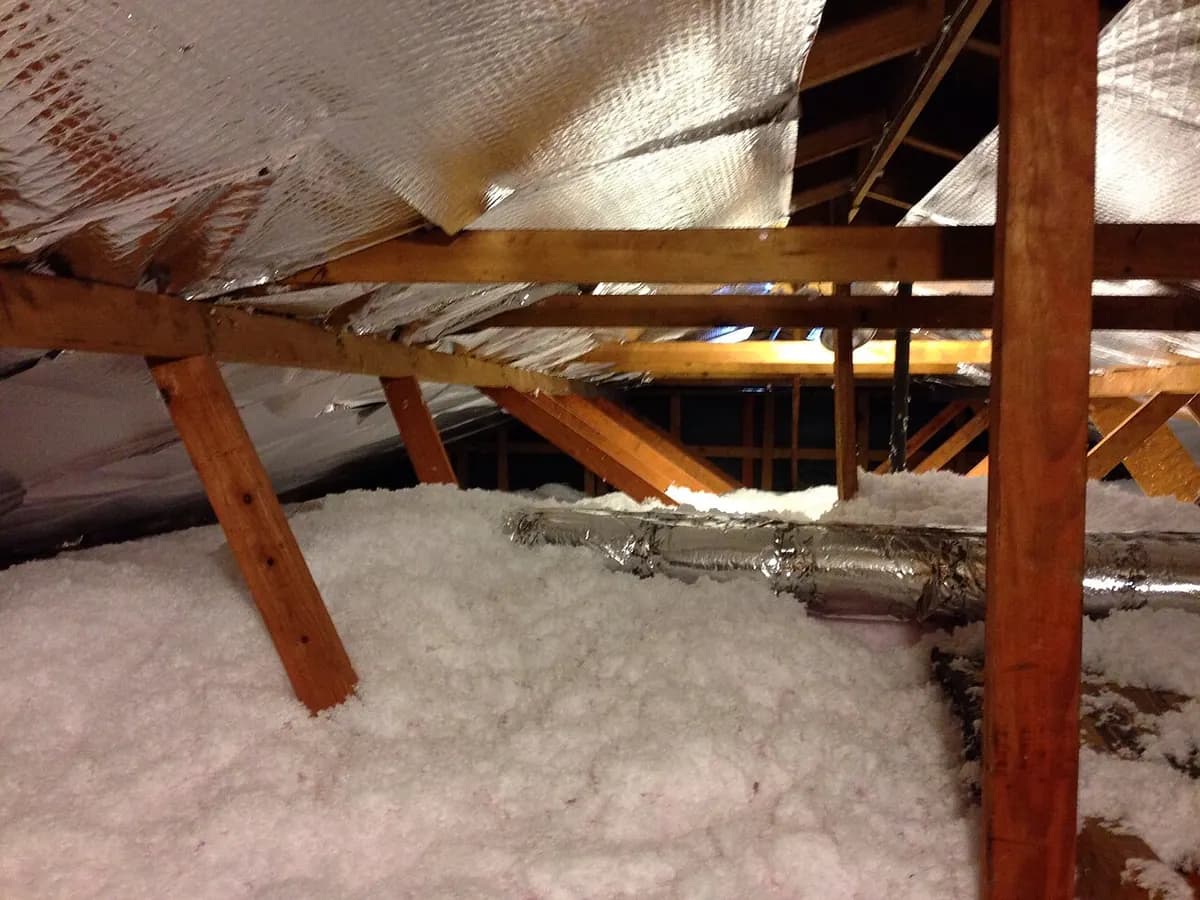
Photo: Jason Dale, “AtticInsulation”, CC BY-SA 3.0, via Wikimedia Commons. Resized and converted to WebP; shown cropped.
Insulation & air sealing
Attic, wall and basement insulation, air sealing, energy audits.
On this page12 sections: urgent, quote, red flags, permits…
Is it urgent?
Gas smell, CO alarm, smoke or a burning smell? That's not an insulation job. Get out and call 911.
Emergency: call now
- Gas smell or CO alarm
- Smoke or burning smell
Within a day or two
- Ice dam leaking inside
- Rebate deadline in days
- Walls about to be closed up
- Bare wall before a cold snap
Can wait: schedule it
- Attic top-up
- High bills or drafty rooms
- Spray foam quote
- Energy audit
The full list, in the guide's words
Safety first: A gas smell, a sounding carbon monoxide alarm, smoke, or a burning or electrical smell is a safety event, not an insulation job. Get out and call 911 or your gas utility. Old vermiculite insulation may contain asbestos, so do not disturb it and have it checked by a qualified professional first.
Emergency: call now
- A gas smell, a sounding carbon monoxide alarm, smoke, or a burning or electrical smell (call 911 or your gas utility first)
Within a day or two
- An active ice dam with water coming into the ceiling, walls or near a light fixture (use a bucket and move belongings, and note that a roofer or plumber may be needed first)
- A rebate or program deadline that is closing within days
- Walls about to be closed up with drywall, since insulation usually has to pass inspection first
- A bare wall or crawlspace at risk of freezing before a cold snap
Can wait: schedule it
- Attic top-ups, high energy bills, drafty rooms and comfort complaints
- Spray foam quotes, basement and crawlspace jobs, energy audits and general estimates
This is general guidance, not a diagnosis. If anyone is in danger, call 911 first.
What's on the quote
Areas & R-valueAsk: how was the R-value chosen?
Which spaces are covered (attic, walls, rim joists, crawlspace) and the target R-value. Ask how the number was chosen for your climate.
MaterialAsk: which type? Compare like with like
Blown-in cellulose or fiberglass, batts, spray foam (open-cell or closed-cell) or rigid foam. Compare like with like.
Air sealingAsk: is it a separate line?
Sealing gaps before insulating. Often a separate line and often the highest-value step.
Prep & removalAsk: old or wet insulation removed?
Removing old, wet or contaminated insulation before new material goes in.
Ventilation bafflesAsk: will attic vents stay open?
Chutes that keep the attic vents open so air can flow.
VerificationAsk: a test or photos of the work?
A before-and-after air-tightness test or photos of the work, since it is hidden once installed.
What a good estimate spells out9 things to look for
- The contractor's legal name, license number if one applies, and contact details, plus your name and address.
- What work is included, and what is not.
- The brand, model and size of major equipment and materials, not just standard or builder grade.
- Who pulls the permit and who pays for it and for inspections.
- Cleanup, and what happens to the old materials.
- A start date and a realistic finish date, and what happens if the schedule slips.
- Warranty terms: what is covered, for how long and who honors it.
- When and how you pay, tied to finished stages of work rather than just dates.
- How changes are handled: a written price for any change before the work happens.
Know what you're looking at
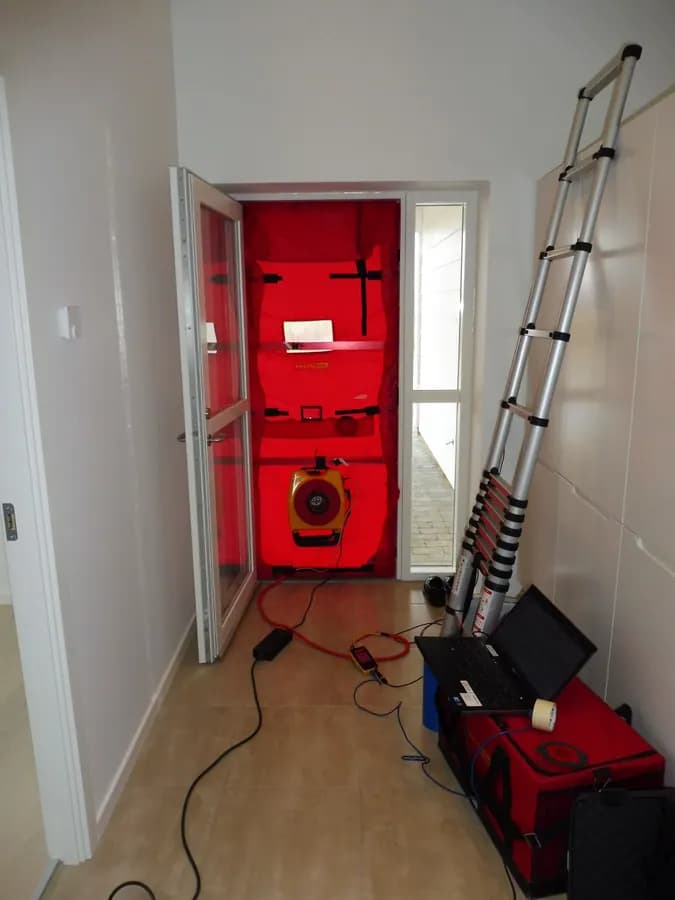
Blower-door test
Measures how leaky the house is

Thermal image
Shows where heat escapes
Red flags
4 of 11"Insulation" and nothing else
Ask for R-value, depth and photos in writing.
Spray foam for everything
One product sold for every problem.
No air sealing or vent plan
Insulation must not block attic vents.
Covering moisture or old wiring
Those need fixing first.
7 more red flags
Pressure to sign today, or a price that is only good right now.
A fair quote is still fair tomorrow.
No written quote, or a quote that is a single total with no detail about what is included.
A large payment up front, or a request for cash only.
Some states limit how much a contractor can ask for before work starts.
A license number that does not check out.
Where your state licenses this trade, look the number up yourself on the state licensing board's site.
No proof of insurance.
Ask for a certificate sent to you directly by the insurer or the agent.
A price far below every other quote, followed by extras once the work has started.
Someone who knocks on your door uninvited, or who will not give recent local references.
Where homeowners say it goes wrong
- High heating/cooling bills and a drafty, uncomfortable house - and they're not sure insulation is even the fix
- One room (often upstairs) is unbearable in summer heat or freezing in winter
- Ice dams keep forming and leaking, and they've been told it's an attic problem
- They're confused by rebates and the tax credit and afraid of missing a deadline or doing the paperwork wrong
- They can't tell open-cell from closed-cell foam, or blown-in from batt, and worry about being upsold
- It's invisible work behind walls/in the attic, so they fear paying for something they can't verify was done right
- They worry about 'sealing the house too tight' causing moisture, mold, or appliance-draft problems
Ask every insulation contractor
What R-value and installed depth are you quoting for each area, and how did you choose them for my climate?
Will you air-seal first and keep the attic vents clear with baffles?
Is there an energy audit or a before-and-after test, and does this work qualify for a rebate I should confirm before signing?
2 more questions
Are you licensed where this work requires it, and insured? Can I see the license number and a certificate of insurance sent to me by your insurer?
What exactly does the warranty cover, for how long, and who honors it (you, the manufacturer, or both)? Will you put it in writing?
Permits
This work rarely needs a permit, although exceptions exist when it touches structure, electrical, plumbing or gas.
Insulation rarely needs a permit. Some areas require inspections for spray foam, new construction and additions, or when wiring or vent changes are involved. Rebate programs may require their own documentation.
- Your building department decides what applies at your address. Rules differ by city and county, and HOA, condo or historic-district rules can add more.
- Ask who pulls the permit. Normally the licensed contractor does and the price includes it. If a contractor asks you to pull it in your own name, ask why: it can shift responsibility for the work to you.
- If you are unsure, call your local building department before you sign. Unpermitted work can cause problems with insurance and when you sell.
Words you'll see
R-value
How well insulation resists heat flow. A higher number means more resistance. The right number depends on the space and your climate.
What this trade covers
11 kinds of jobsAs the trade lists them
- Attic insulation top-up and full re-insulation (blown-in cellulose or fiberglass)
- Air-sealing / weatherization (top plates, penetrations, attic hatch, recessed-light covers, rim joist)
- Spray foam insulation: open-cell and closed-cell (rim joist, crawlspace, attic deck, cathedral ceilings, additions)
- Dense-pack blown-in insulation for existing closed walls (drill-and-fill)
- Fiberglass and mineral-wool batt insulation (new walls, basements, garages, additions)
- Crawlspace and basement insulation and encapsulation (vapor barrier, rim-joist foam)
- Ice-dam prevention (air-seal + insulate + improve attic ventilation/baffles)
- Home energy assessment / audit (blower-door test + infrared scan) (often the first step for rebates)
- Insulation removal and remediation (rodent-contaminated, mold, water-damaged; vermiculite routed to abatement)
- Sound-dampening / acoustic insulation
- Rebate- and tax-credit-driven energy-efficiency upgrades (utility programs, federal 25C credit, weatherization assistance)
How people describe itUrgent calls and planned ones
When it can't wait
- “Water is leaking into my ceiling from an ice dam on the roof right now”
- “There's water coming down the wall near a light fixture and there's ice built up on the edge of the roof”
- “My pipes in the crawlspace might freeze tonight, it's bare in there with no insulation”
- “The drywall guys come tomorrow and the insulation still isn't in - I need someone today before they close up the walls”
- “I have to get the insulation done before the rebate deadline this week or I lose the money”
- “My upstairs is so hot in this heat wave nobody can sleep up there”
When it can be planned
- “My energy bills are really high and I think my attic needs more insulation”
- “I want a quote for spray foam in my crawlspace”
- “One bedroom is always colder than the rest of the house - can someone take a look”
- “I'd like a home energy audit to see what I should do”
- “I'm building an addition and need batt insulation in the new walls”
- “I want to top up the old fiberglass in my attic”
- “I heard there's a rebate for insulation and want to know what I qualify for”
- “There's old insulation in the attic that got rodent damage and I want it removed and replaced”
Rebates and credits
Rebates and credits change often and differ by state, utility and sometimes county.
- Start with your state energy office and the ENERGY STAR rebate finder.ENERGY STAR rebate finder (opens in a new tab)
- The federal 25C and 25D credits ended for property placed in service after 2025-12-31 (IRS: 25C, 25D). Do not count on them for new work, and ask a tax professional about your situation.25C (opens in a new tab)25D (opens in a new tab)
- Insulation and air sealing are among the efficiency upgrades that utilities and state programs most often support, and some programs require an energy audit first.
- Programs often have conditions: a specific equipment rating, an approved installer, or approval before you buy. Confirm the rules before you sign, not after.
Paying for it
Before you finance anything6 basics, then the financing guide
Most home projects can be paid in cash or financed. A few basics before you sign anything:
- Ask for the cash price and the financed price in writing, for the same scope of work. They can differ, because a financing fee (sometimes called a dealer fee) may be built into the financed price.
- Compare the total you will pay over the whole loan, not just the monthly payment.
- Read the fine print on same-as-cash and zero-interest offers, especially what happens if the balance is not paid in full by the end of the promotional period.
- PACE financing is repaid through your property tax bill and can place a lien on your home. Read the terms closely, and consider asking your mortgage servicer how it is treated, before you agree.
- Utility and state programs sometimes offer low-rate loans for efficiency work. Check yours before accepting the contractor's offer.
- Take loan paperwork home and read it. A sign-it-today loan is a reason to slow down.
There is more in the financing guide.financing guide
We are not a lender and do not arrange loans. Financing information here is general education; lenders decide terms.
What an expert knows
Short notes from public sources such as federal agencies, safety groups and trade associations. Each note links to the page it came from, and every page was opened and read on 2026-10-03. This is a starting point, not a complete list of every rule or program, and it is general information, not legal, tax, engineering or insurance advice. Rules and prices vary by place, so confirm what applies at your address.
Types, pros, cons and lifespan6 notes, each with its source
- Loose-fill fiberglass or rock wool: Blown-in fibers. Used for attics. ENERGY STAR's inspection guide counts about 2.5 R-value per inch of loose fiberglass and about 2.8 per inch of rock wool when you measure existing depth.ENERGY STAR: DIY Checks and Inspections for Insulation and Air Leaks (opens in a new tab)
- Loose-fill cellulose: Small gray flat pieces or fibers made from newsprint. About 3.7 R-value per inch in ENERGY STAR's measuring guide, the highest per-inch figure among the common attic types it lists.ENERGY STAR: DIY Checks and Inspections for Insulation and Air Leaks (opens in a new tab)
- Fiberglass batts: Pre-cut blankets. About 3.2 R-value per inch in ENERGY STAR's measuring guide.ENERGY STAR: DIY Checks and Inspections for Insulation and Air Leaks (opens in a new tab)
- Vermiculite or perlite granules: A pour-in granular insulation. About 2.7 R-value per inch, but vermiculite may contain asbestos, so see the safety notes below.ENERGY STAR: DIY Checks and Inspections for Insulation and Air Leaks (opens in a new tab)
- Spray polyurethane foam: Comes as high-pressure and low-pressure two-part systems mixed during application, plus one-component aerosol cans. The two-part products contain isocyanates, so installers need training and you should discuss safety steps first.CPSC: Spray Polyurethane Foam Insulation, Health and Safety Recommendations for Consumers (opens in a new tab)
- Right product for the right place: Not every insulation suits every part of the house. ENERGY STAR keeps a product finder for certified insulation.ENERGY STAR: Seal and Insulate (opens in a new tab)
Sizing and choosing5 notes, each with its source
- R-value targets depend on climate zone: R-value measures resistance to heat flow, and higher is better. ENERGY STAR publishes recommended levels by climate zone and by location in the house, based on the 2021 International Energy Conservation Code.ENERGY STAR: Recommended Home Insulation R-Values (opens in a new tab)
- Quick attic check: If insulation is level with or below the floor joists, you probably need more. If you cannot see the joists because it sits well above them, you probably have enough.ENERGY STAR: DIY Checks and Inspections for Insulation and Air Leaks (opens in a new tab)
- Measure and multiply: Measure the depth in inches and multiply by the per-inch figure for your material, or read the R-value printed on batts, then compare with the recommendation for your zone.ENERGY STAR: DIY Checks and Inspections for Insulation and Air Leaks (opens in a new tab)
- Even coverage counts: Insulation should be evenly distributed with no low spots. Some attics have plenty in the middle and very little along the eaves.ENERGY STAR: DIY Checks and Inspections for Insulation and Air Leaks (opens in a new tab)
- Walls: Exterior walls should be insulated and fully filled. You can check using an electrical outlet.ENERGY STAR: DIY Checks and Inspections for Insulation and Air Leaks (opens in a new tab)
Maintenance by season4 notes, each with its source
- Before winter: Check the attic insulation level and make sure it is even, including along the eaves. Wear gloves, a mask and safety glasses, and walk only on joists.ENERGY STAR: DIY Checks and Inspections for Insulation and Air Leaks (opens in a new tab)
- Find air leaks yourself: Try a light test (a flashlight at night with a partner outside) or a smoke test with incense on a cool, very windy day with combustion appliances turned off. Where light shows through or smoke is pulled, there is a leak.ENERGY STAR: DIY Checks and Inspections for Insulation and Air Leaks (opens in a new tab)
- Winter warning signs: Ice dams, drafty rooms and cold floors point to attic or basement air sealing and insulation work.ENERGY STAR: Identify Air Leak and Insulation Problems (opens in a new tab)
- Ducts: High heating or cooling bills and dust or smells from the attic or crawlspace are common duct problems.ENERGY STAR: Identify Air Leak and Insulation Problems (opens in a new tab)
Code and permit basics5 notes, each with its source
- Energy code basis: ENERGY STAR's retrofit recommendations follow the 2021 IECC residential tables, but local code governs. Ask your building department which edition applies to you. This is general information, not legal advice.ENERGY STAR: Recommended Home Insulation R-Values (opens in a new tab)
- Vermiculite may hold asbestos: Vermiculite from the Libby, Montana mine was often sold as Zonolite. If you have vermiculite insulation, assume it may be contaminated and do not disturb it.EPA: Protect Your Family from Asbestos-Contaminated Vermiculite Insulation (opens in a new tab)
- Test before touching: ENERGY STAR advises not disturbing vermiculite until an approved lab has tested it. Your local health department can name a lab.ENERGY STAR: DIY Checks and Inspections for Insulation and Air Leaks (opens in a new tab)
- Combustion safety: Sealing a house or its ducts can cause water heaters and similar appliances to backdraft. A home energy professional can test for this before air sealing begins.ENERGY STAR: Identify Air Leak and Insulation Problems (opens in a new tab)
- Spray foam re-entry: Industry guidance is to vacate during and for at least 24 hours after installation, though emissions vary by product and building.CPSC: Spray Polyurethane Foam Insulation, Health and Safety Recommendations for Consumers (opens in a new tab)
What moves the price5 notes, each with its source
- Scope: Projects range from weatherstripping and caulk to bigger jobs such as sealing and insulating the attic or basement. The bigger the area and the harder the access, the more the job costs.ENERGY STAR: Seal and Insulate (opens in a new tab)
- Hidden hazards: Vermiculite and sharp roofing nails in the attic can add testing or safety steps before work.ENERGY STAR: DIY Checks and Inspections for Insulation and Air Leaks (opens in a new tab)
- Material choice: Different materials deliver different R-value per inch, so the depth needed for a given target changes with the product.ENERGY STAR: DIY Checks and Inspections for Insulation and Air Leaks (opens in a new tab)
- Air sealing first: ENERGY STAR pairs air sealing with insulation. Sealing leaks and ducts is extra scope, so ask for it priced as its own line.ENERGY STAR: Identify Air Leak and Insulation Problems (opens in a new tab)
- Professional assessment: A comprehensive energy audit by a home energy professional can find hidden air leaks, point to specific solutions and flag safety issues.ENERGY STAR: DIY Checks and Inspections for Insulation and Air Leaks (opens in a new tab)
Common scams4 notes, each with its source
- Door-knocking offers: Uninvited workers claiming to be in the area are a common home improvement scam pattern.FTC: How To Avoid a Home Improvement Scam (opens in a new tab)
- Pressure to sign today: Discounts that only last if you sign right now are a warning sign.FTC: How To Avoid Scams After Weather Emergencies and Natural Disasters (opens in a new tab)
- Told to rip out old vermiculite: EPA says to assume vermiculite may be contaminated. Be careful with anyone who disturbs it without testing and proper precautions.EPA: Protect Your Family from Asbestos-Contaminated Vermiculite Insulation (opens in a new tab)
- Paying up front: Do not pay the full price up front, and avoid cash or wire payments.FTC: How To Avoid a Home Improvement Scam (opens in a new tab)
Ask for this in writing4 notes, each with its source
- Target R-value and material: The product, the R-value you are buying and the finished depth, matched to your climate zone.ENERGY STAR: Recommended Home Insulation R-Values (opens in a new tab)
- Air sealing scope: Which leaks will be sealed and where, and whether a combustion safety test is done before and after.ENERGY STAR: Identify Air Leak and Insulation Problems (opens in a new tab)
- Safety plan: For spray foam, how the contractor will protect you and for how long you must be out of the house.CPSC: Spray Polyurethane Foam Insulation, Health and Safety Recommendations for Consumers (opens in a new tab)
- Estimate and contract basics: The work to be done, materials, completion date and price, plus license number and your cancellation right where it applies.FTC: How To Avoid a Home Improvement Scam (opens in a new tab)
Repair or replace3 notes, each with its source
- Add or leave alone: If insulation sits well above the joists, adding more may not be cost-effective. If it is level with or below them, you probably need more.ENERGY STAR: DIY Checks and Inspections for Insulation and Air Leaks (opens in a new tab)
- Do not disturb vermiculite: Leave it alone until tested. Do not try to clean or remove it yourself.EPA: Protect Your Family from Asbestos-Contaminated Vermiculite Insulation (opens in a new tab)
- Seal and insulate together: ENERGY STAR pairs the two: sealing air leaks and adding insulation together improve comfort and efficiency, so ask what sealing is included.ENERGY STAR: Seal and Insulate (opens in a new tab)
Questions to ask an expert4 notes, each with its source
- What R-value do you recommend for my climate zone, and what depth will that be? Ask them to show the ENERGY STAR recommendation for your area.ENERGY STAR: Recommended Home Insulation R-Values (opens in a new tab)
- Is there vermiculite or other hazard in my attic? If so, ask about testing before work starts.EPA: Protect Your Family from Asbestos-Contaminated Vermiculite Insulation (opens in a new tab)
- Will you test combustion appliances before and after sealing? Backdrafting is a real risk after tightening a home.ENERGY STAR: Identify Air Leak and Insulation Problems (opens in a new tab)
- If you use spray foam, how long do we stay out? Ask for the manufacturer's re-entry guidance in writing.CPSC: Spray Polyurethane Foam Insulation, Health and Safety Recommendations for Consumers (opens in a new tab)
General information, not legal, tax, engineering or insurance advice. Photos credited with their licenses; drawings made for this site. Guide updated October 3, 2026.