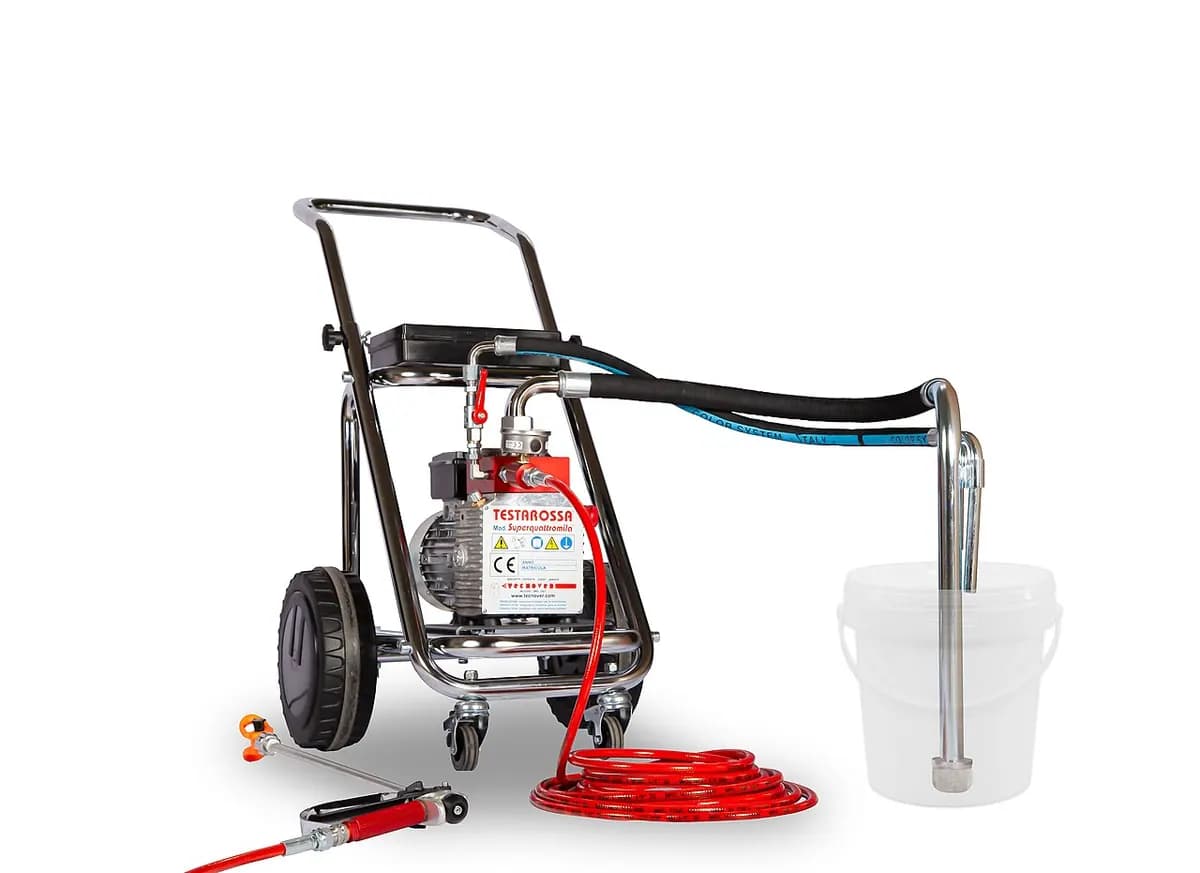
Photo: Steve Purpy, “Pompa Airless TECNOVER Testarossa Superquattromila”, CC BY-SA 4.0, via Wikimedia Commons. Resized and converted to WebP; shown cropped.
Painting
Interior and exterior painting, staining, drywall touch-ups.
On this page10 sections: urgent, quote, red flags, permits…
Is it urgent?
Strong fumes? Open windows and move people outside. In an older home, don't sand or scrape old paint yourself.
Emergency: call now
- Damage that must be sealed
- Bare wood, storm coming
- Strong fumes, people inside
- Mold bleeding through paint
Within a day or two
- Move-in or event deadline
- Patches to cover quickly
- Recoat before an inspection
Can wait: schedule it
- Interior or exterior repaint
- Cabinet refinishing
- Color consultation
- Deck staining
The full list, in the guide's words
Safety first: If fumes are strong in an occupied space, open windows, move people outside (especially infants, older adults and anyone with breathing problems), and call poison control or your doctor if anyone feels unwell. In an older home, do not dry-sand or scrape old paint yourself, because it may contain lead.
Emergency: call now
- Water, fire or smoke damage where bare surfaces must be sealed before more damage happens
- Bare exposed wood or substrate with a storm about to hit
- A failing job: a coating that stays tacky before weather, or strong fumes in an occupied home with infants, older adults or health concerns
- Mold bleeding through paint, or any other health or safety concern
Within a day or two
- A move-in, move-out or event deadline
- Small visible patches you need covered quickly
- A coat that needs a recoat before a scheduled inspection
Can wait: schedule it
- Standard interior and exterior repaints, cabinet refinishing, color consultations and deck staining
- The vast majority of estimate requests
This is general guidance, not a diagnosis. If anyone is in danger, call 911 first.
What's on a painting quote
PrepAsk: exactly what prep is included?
Scraping, sanding, patching, caulking and priming. The biggest factor in how long paint lasts, so ask exactly what is included.
PaintAsk: brand, line, sheen, coats
The brand, product line, sheen and number of coats.
LaborAsk: by room, square foot or day?
By the room, by square foot or by the day. Ask which.
Protection & cleanupAsk: floors, furniture, plants covered?
Masking, drop cloths and covering of floors, furniture and plants.
What gets paintedAsk: ceilings, trim, doors included?
Ceilings, trim, doors, closets and cabinets are often priced separately.
Lead-safe workAsk: home built before 1978?
In homes built before 1978, extra containment and cleanup can apply.
What a good estimate spells out9 things to look for
- The contractor's legal name, license number if one applies, and contact details, plus your name and address.
- What work is included, and what is not.
- The brand, model and size of major equipment and materials, not just standard or builder grade.
- Who pulls the permit and who pays for it and for inspections.
- Cleanup, and what happens to the old materials.
- A start date and a realistic finish date, and what happens if the schedule slips.
- Warranty terms: what is covered, for how long and who honors it.
- When and how you pay, tied to finished stages of work rather than just dates.
- How changes are handled: a written price for any change before the work happens.
Red flags
4 of 11No detail on prep and primer
A low price often means skipped prep.
Coats, product or sheen missing
Ask for the number of coats in writing.
Lead-safe rules waved away
Pre-1978 homes need lead-safe work.
Spraying with no masking plan
Floors, plants and neighbors need covering.
7 more red flags
Pressure to sign today, or a price that is only good right now.
A fair quote is still fair tomorrow.
No written quote, or a quote that is a single total with no detail about what is included.
A large payment up front, or a request for cash only.
Some states limit how much a contractor can ask for before work starts.
A license number that does not check out.
Where your state licenses this trade, look the number up yourself on the state licensing board's site.
No proof of insurance.
Ask for a certificate sent to you directly by the insurer or the agent.
A price far below every other quote, followed by extras once the work has started.
Someone who knocks on your door uninvited, or who will not give recent local references.
Where homeowners say it goes wrong
- No-shows or vague 'I'll get you a quote' with no follow-through
- Sticker shock and confusing quotes with no breakdown of prep vs. paint
- Worry the painter will cut corners on prep, primer, or the second coat
- Mess, overspray, fumes, and not knowing if the crew is licensed/insured or lead-safe certified
Ask every painter
What prep is included (scraping, sanding, patching, caulking, priming), and what is not?
Which exact paint product and sheen, how many coats, and who supplies the paint?
Is your firm lead-safe certified, and does my home's age mean those rules apply to this job?
2 more questions
Are you licensed where this work requires it, and insured? Can I see the license number and a certificate of insurance sent to me by your insurer?
What exactly does the warranty cover, for how long, and who honors it (you, the manufacturer, or both)? Will you put it in writing?
Permits
This work rarely needs a permit, although exceptions exist when it touches structure, electrical, plumbing or gas.
Painting almost never needs a permit. Exceptions include historic-district or HOA color rules, scaffolding or lifts over a public way, and repairs that involve structure, electrical or plumbing.
- Your building department decides what applies at your address. Rules differ by city and county, and HOA, condo or historic-district rules can add more.
- Ask who pulls the permit. Normally the licensed contractor does and the price includes it. If a contractor asks you to pull it in your own name, ask why: it can shift responsibility for the work to you.
- If you are unsure, call your local building department before you sign. Unpermitted work can cause problems with insurance and when you sell.
Words you'll see
Cut in
Painting the edges and corners by brush before rolling the large surfaces. A sign of careful work when the lines are straight.
What this trade covers
13 kinds of jobsAs the trade lists them
- Interior repaint (walls, ceilings, trim)
- Exterior house repaint (siding, soffits, fascia)
- Cabinet refinishing and respraying
- Drywall patching, skim coating, and texture matching
- Deck and fence staining/sealing
- Wallpaper removal and surface prep
- Power washing / pressure washing before exterior coats
- Trim, door, and crown molding enamel work
- Popcorn ceiling removal and ceiling repaint
- Color consultation and sample matching
- Stucco and masonry painting (elastomeric coatings)
- Lead-safe (RRP) repaints on pre-1978 homes
- Epoxy garage and concrete floor coatings
How people describe itUrgent calls and planned ones
When it can't wait
- “A pipe burst and there's a huge brown water stain spreading across my ceiling”
- “We just had a fire and the smoke turned all the walls yellow and black”
- “My exterior paint is peeling off in sheets and bare wood is exposed before the storm this weekend”
- “There's mold growing through the paint in my bathroom and it keeps coming back”
- “The freshly painted nursery still reeks of fumes and my newborn comes home tomorrow”
- “Water is coming through the wall and the paint is bubbling up everywhere”
- “The deck sealer never dried and it's tacky and the rain is coming”
When it can be planned
- “I'd like a quote to repaint my living room and hallway”
- “How much to paint the exterior of a two-story colonial?”
- “Can someone come do a color consultation?”
- “I want to refinish my kitchen cabinets, what's the cost?”
- “Looking to get my deck stained and sealed this spring”
- “Do you do popcorn ceiling removal?”
Paying for it
Before you finance anything6 basics, then the financing guide
Most home projects can be paid in cash or financed. A few basics before you sign anything:
- Ask for the cash price and the financed price in writing, for the same scope of work. They can differ, because a financing fee (sometimes called a dealer fee) may be built into the financed price.
- Compare the total you will pay over the whole loan, not just the monthly payment.
- Read the fine print on same-as-cash and zero-interest offers, especially what happens if the balance is not paid in full by the end of the promotional period.
- PACE financing is repaid through your property tax bill and can place a lien on your home. Read the terms closely, and consider asking your mortgage servicer how it is treated, before you agree.
- Utility and state programs sometimes offer low-rate loans for efficiency work. Check yours before accepting the contractor's offer.
- Take loan paperwork home and read it. A sign-it-today loan is a reason to slow down.
There is more in the financing guide.financing guide
We are not a lender and do not arrange loans. Financing information here is general education; lenders decide terms.
What an expert knows
Short notes from public sources such as federal agencies, safety groups and trade associations. Each note links to the page it came from, and every page was opened and read on 2026-10-03. This is a starting point, not a complete list of every rule or program, and it is general information, not legal, tax, engineering or insurance advice. Rules and prices vary by place, so confirm what applies at your address.
Types, pros, cons and lifespan6 notes, each with its source
- Acrylic latex paint: Water-based, flexible and very durable. A good acrylic latex exterior paint generally outlasts a good oil-based paint. Latex is more porous and lets walls breathe while it sheds water.USDA Forest Products Laboratory: Paint, Stain, Varnish, or Preservative? It's Your Choice (opens in a new tab)
- Oil-based or alkyd paint: Pigment in an oil vehicle. It tends to become brittle with age, and if water enters the wall from inside it is more likely to get trapped and cause blistering.USDA Forest Products Laboratory: Paint, Stain, Varnish, or Preservative? It's Your Choice (opens in a new tab)
- Primers: Woods like redwood and cedar have extractives that bleed through latex. Seal them with an oil-based or stain-blocking latex primer, then topcoat with acrylic latex.USDA Forest Products Laboratory: Paint, Stain, Varnish, or Preservative? It's Your Choice (opens in a new tab)
- Film-forming versus penetrating: Paints, solid-color stains and varnishes form a film on the wood. Preservatives, water repellents and semitransparent stains soak in.USDA Forest Products Laboratory: Paint, Stain, Varnish, or Preservative? It's Your Choice (opens in a new tab)
- Typical finish life outdoors: Water repellents last about 6 to 12 months, clear preservatives 1 to 2 years, pigmented ones 2 to 3, varnish 2 to 3, solid-color stains 3 to 7, semitransparent stains 3 to 8 and paints 7 or more years.USDA Forest Products Laboratory: Paint, Stain, Varnish, or Preservative? It's Your Choice (opens in a new tab)
- Strippers and sprays: Paint strippers, adhesive removers and aerosol spray paints can contain methylene chloride. Use them outdoors when possible and indoors only with good ventilation.EPA: Volatile Organic Compounds' Impact on Indoor Air Quality (opens in a new tab)
Sizing and choosing4 notes, each with its source
- What to weigh: Appearance, durability, cost, surface type, ease of application and maintenance all matter when choosing an exterior finish. Every choice involves trade-offs.USDA Forest Products Laboratory: Paint, Stain, Varnish, or Preservative? It's Your Choice (opens in a new tab)
- Paint does not stop decay: A finish only slows moisture changes by blocking liquid water. It will not prevent decay if conditions favor fungus.USDA Forest Products Laboratory: Paint, Stain, Varnish, or Preservative? It's Your Choice (opens in a new tab)
- Fix water before paint: If water from a roof leak has soaked a wall and the paint is buckling, fix the water problem first and then paint.EPA: Mold House Tour (text version) (opens in a new tab)
- Buy what you will use: For paints and similar products you use only occasionally, buy only as much as you will use right away.EPA: Volatile Organic Compounds' Impact on Indoor Air Quality (opens in a new tab)
Maintenance by season4 notes, each with its source
- Repaint on time: Wood is easier to repaint before the first coat fails. Penetrating finishes can be refreshed by refinishing when mildew or other changes discolor them.USDA Forest Products Laboratory: Paint, Stain, Varnish, or Preservative? It's Your Choice (opens in a new tab)
- Ventilate while painting: Increase ventilation when using products that emit VOCs, and follow label precautions. Open windows or run an exhaust fan.EPA: Volatile Organic Compounds' Impact on Indoor Air Quality (opens in a new tab)
- Store and discard safely: Gases can leak even from closed containers, so store leftovers in a ventilated place out of children's reach and use local collection days for unwanted products.EPA: Volatile Organic Compounds' Impact on Indoor Air Quality (opens in a new tab)
- Mildew and moisture: Do not paint over wet or moldy walls. Clean up the mold and dry the surface first, because paint over mold will likely peel.EPA: Mold House Tour (text version) (opens in a new tab)
Code and permit basics4 notes, each with its source
- Pre-1978 homes: Anyone paid to disturb painted surfaces in a home built before 1978 must be certified in lead-safe work practices. In general the rule does not apply to homeowners working in their own home. This is general information, not legal advice.EPA: Lead Renovation, Repair and Painting Program (opens in a new tab)
- What lead-safe work looks like: The work area is contained with warning signs, plastic and tape. Sanding, cutting and demolition create lead dust, and cleanup ends with a cleaning verification using disposable cloths and an EPA card.EPA: The Lead-Safe Certified Guide to Renovate Right (opens in a new tab)
- Notice before work: Federal law requires the lead pamphlet to be delivered before renovating more than six square feet of painted surface in a room inside, or more than twenty square feet outside, in housing built before 1978.EPA: The Lead-Safe Certified Guide to Renovate Right (opens in a new tab)
- VOC limits: No federally enforceable standards exist for VOCs in non-industrial settings, so the label precautions and good ventilation are your protection.EPA: Volatile Organic Compounds' Impact on Indoor Air Quality (opens in a new tab)
What moves the price4 notes, each with its source
- Surface prep and priming: Stripping failed paint, sealing bleeding woods and fixing moisture problems come before the topcoat and change the price.USDA Forest Products Laboratory: Paint, Stain, Varnish, or Preservative? It's Your Choice (opens in a new tab)
- Finish type and repaint cycle: Finishes that last longer are redone less often. Water repellents need redoing far more often than paint.USDA Forest Products Laboratory: Paint, Stain, Varnish, or Preservative? It's Your Choice (opens in a new tab)
- Lead-safe work: In pre-1978 homes, containment, special cleaning and verification add steps.EPA: The Lead-Safe Certified Guide to Renovate Right (opens in a new tab)
- Leftover product: Buying only what you will use avoids leftover paint to store or dispose of through local collection days.EPA: Volatile Organic Compounds' Impact on Indoor Air Quality (opens in a new tab)
Common scams4 notes, each with its source
- Not lead-safe certified: A painter who will disturb paint in a pre-1978 home without being certified in lead-safe work is breaking the rule and putting your family at risk.EPA: Lead Renovation, Repair and Painting Program (opens in a new tab)
- Door-knocking offers: Uninvited painters who say they have leftover paint or are in the area are a common scam pattern.FTC: How To Avoid a Home Improvement Scam (opens in a new tab)
- Cash only, pay in full: Never pay everything up front, and avoid cash or wire payments.FTC: How To Avoid a Home Improvement Scam (opens in a new tab)
- Painting over problems: Paint over mold or wet wood hides the problem for a short time and then peels.EPA: Mold House Tour (text version) (opens in a new tab)
Ask for this in writing4 notes, each with its source
- Prep scope: What will be scraped, stripped, caulked, primed and repaired before painting.USDA Forest Products Laboratory: Paint, Stain, Varnish, or Preservative? It's Your Choice (opens in a new tab)
- Products by name: The primer and topcoat brand and type, such as acrylic latex, for each surface.USDA Forest Products Laboratory: Paint, Stain, Varnish, or Preservative? It's Your Choice (opens in a new tab)
- Lead-safe certification: For a home built before 1978, the firm's EPA lead-safe certification and the cleaning verification at the end.EPA: Lead Renovation, Repair and Painting Program (opens in a new tab)
- Ventilation plan: How the room will be ventilated during and after painting.EPA: Volatile Organic Compounds' Impact on Indoor Air Quality (opens in a new tab)
Repair or replace3 notes, each with its source
- Repaint or strip: Press a strong adhesive tape on the paint and snap it off. If the paint comes off, it is time to strip even if it looks intact.USDA Forest Products Laboratory: Paint, Stain, Varnish, or Preservative? It's Your Choice (opens in a new tab)
- Latex over brittle oil: Latex shrinks as it cures, and over brittle old oil paint it can pull the old paint off, which usually means the old paint was failing anyway.USDA Forest Products Laboratory: Paint, Stain, Varnish, or Preservative? It's Your Choice (opens in a new tab)
- Peeling after a leak: Do not just repaint. Find and fix the water source, since paint applied over moisture or mold will peel.EPA: Mold House Tour (text version) (opens in a new tab)
Questions to ask an expert4 notes, each with its source
- Is my home pre-1978, and are you lead-safe certified? Ask how the work area will be contained and verified.EPA: Lead Renovation, Repair and Painting Program (opens in a new tab)
- What primer and topcoat will you use? Ask why they suit the siding and climate.USDA Forest Products Laboratory: Paint, Stain, Varnish, or Preservative? It's Your Choice (opens in a new tab)
- How will you prep the surface? Ask about stripping, caulking and moisture repairs.USDA Forest Products Laboratory: Paint, Stain, Varnish, or Preservative? It's Your Choice (opens in a new tab)
- How will you handle the fumes? Ask about ventilation and any low-VOC product.EPA: Volatile Organic Compounds' Impact on Indoor Air Quality (opens in a new tab)
General information, not legal, tax, engineering or insurance advice. Photos credited with their licenses; drawings made for this site. Guide updated October 3, 2026.