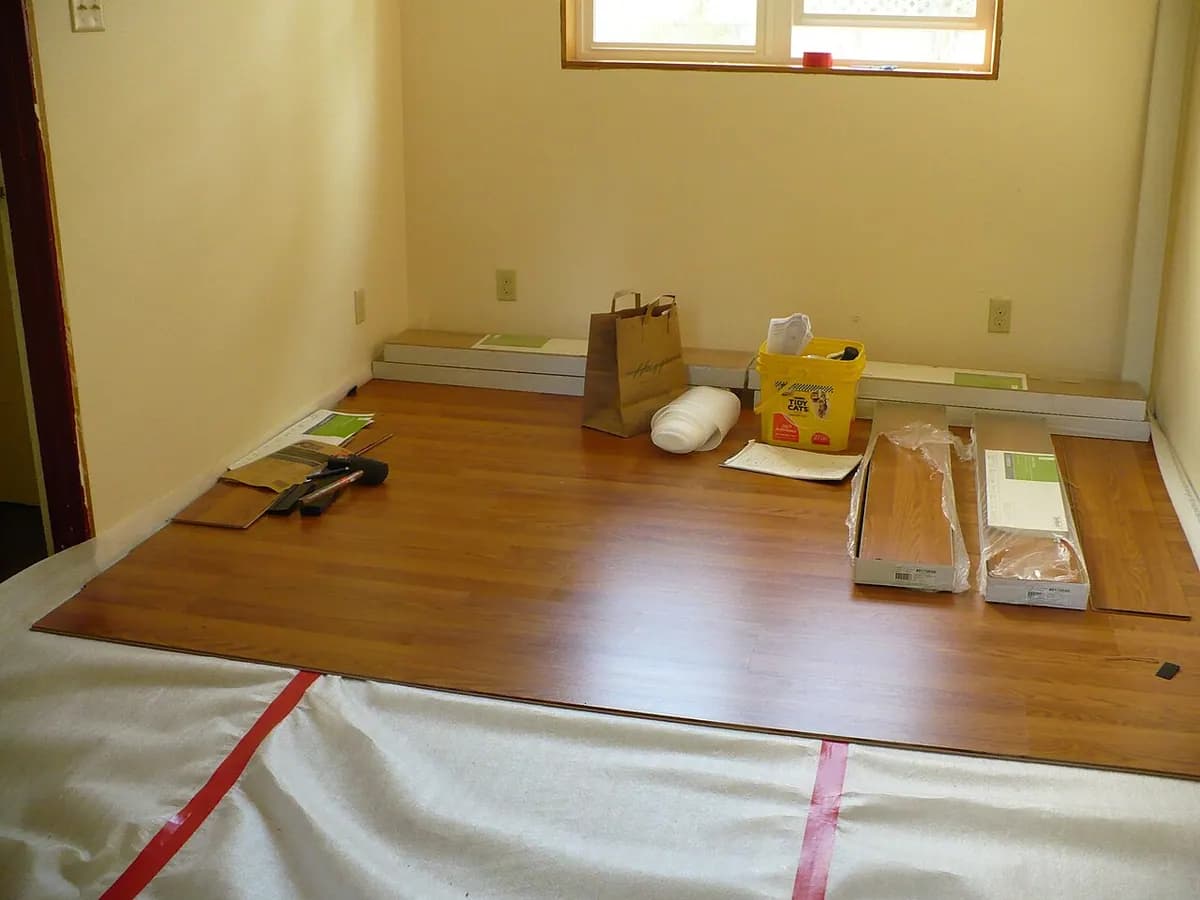
Photo: Suzcp6, “Halfway to done”, CC BY-SA 4.0, via Wikimedia Commons. Resized and converted to WebP; shown cropped.
Flooring
Hardwood, laminate, vinyl, tile, carpet, refinishing.
On this page11 sections: urgent, quote, red flags, permits…
Is it urgent?
Water on the floor? Stop the source first and keep power off near standing water.
Emergency: call now
- Fresh water on the floor
- Boards buckling or swelling
- Soft subfloor
- Tile or board: trip hazard
Within a day or two
- Install stalled partway
- Move-in or event deadline
- Mold from an old slow leak
Can wait: schedule it
- Quote or measuring
- New floor install
- Refinishing
- Regrouting or carpet stretch
The full list, in the guide's words
Safety first: If water is on the floor, stop the source first (shut off the supply or the appliance) and keep power off near standing water. Then call a plumber or a water-damage pro.
Emergency: call now
- Recent water on the floor from a burst pipe, an appliance leak or a water heater leak, with boards buckling, cupping or swelling, or a soft subfloor
- A lifted or cracked tile or a popped board that is a trip hazard, especially in a high-traffic area or for an older adult
Within a day or two
- An install that has stalled partway
- A floor that must be finished before a move-in or an event date
- Mold concerns from an older, slow leak
Can wait: schedule it
- Quotes, measuring and new installations
- Refinishing, regrouting, carpet stretching and cosmetic repairs
This is general guidance, not a diagnosis. If anyone is in danger, call 911 first.
What's on a flooring quote
MaterialsAsk: product, thickness, wear layer
The product by name, thickness and wear layer or grade, plus extra for cuts and waste.
Subfloor prepAsk: how is leveling priced?
Leveling, patching and moisture checks. The most common source of surprise add-ons, so ask how it is priced.
Removal & disposalAsk: is the old floor hauled away?
Pulling up and hauling away the old flooring.
LaborAsk: per square foot or per room?
Per square foot or per room. Ask what is included.
Trim & transitionsAsk: are baseboards put back?
The strips between rooms, and whether baseboards are removed and put back.
Moving furnitureAsk: included, or left to you?
Whether it is included or left to you.
What a good estimate spells out9 things to look for
- The contractor's legal name, license number if one applies, and contact details, plus your name and address.
- What work is included, and what is not.
- The brand, model and size of major equipment and materials, not just standard or builder grade.
- Who pulls the permit and who pays for it and for inspections.
- Cleanup, and what happens to the old materials.
- A start date and a realistic finish date, and what happens if the schedule slips.
- Warranty terms: what is covered, for how long and who honors it.
- When and how you pay, tied to finished stages of work rather than just dates.
- How changes are handled: a written price for any change before the work happens.
Know what you're looking at
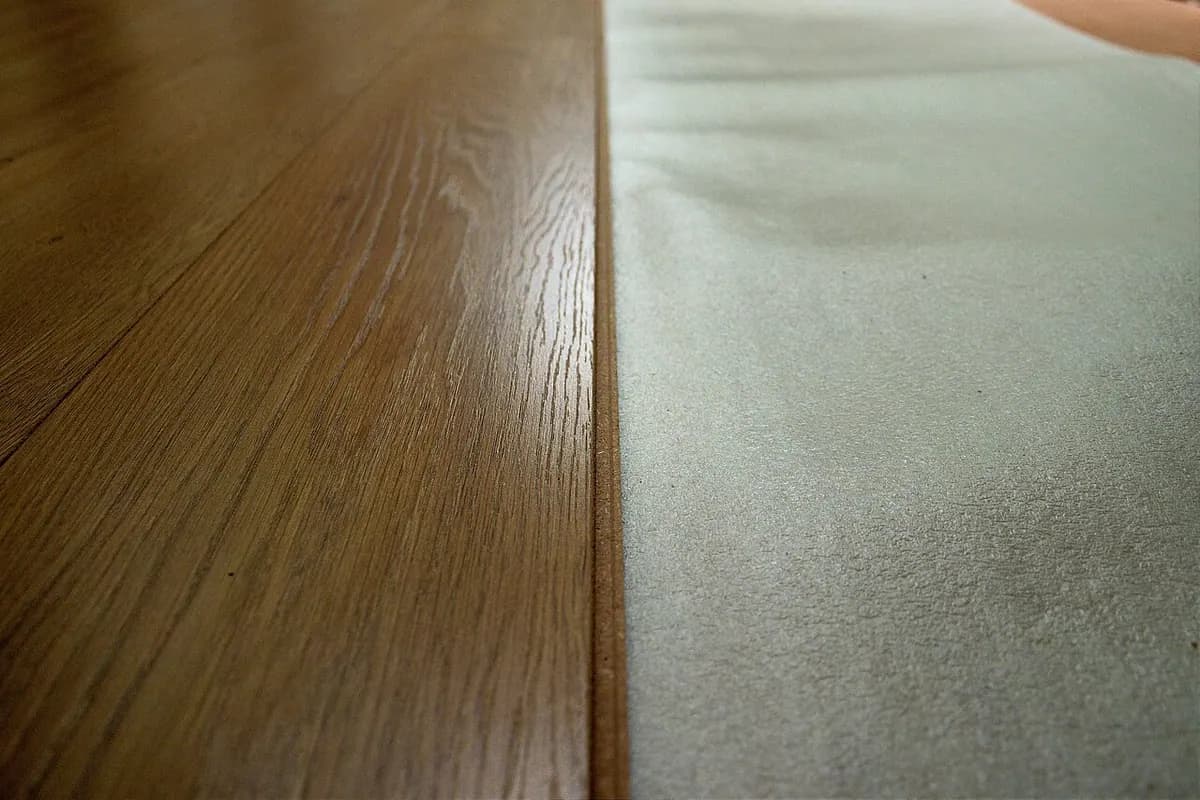
Click-together planks
Floating floor over foam underlayment
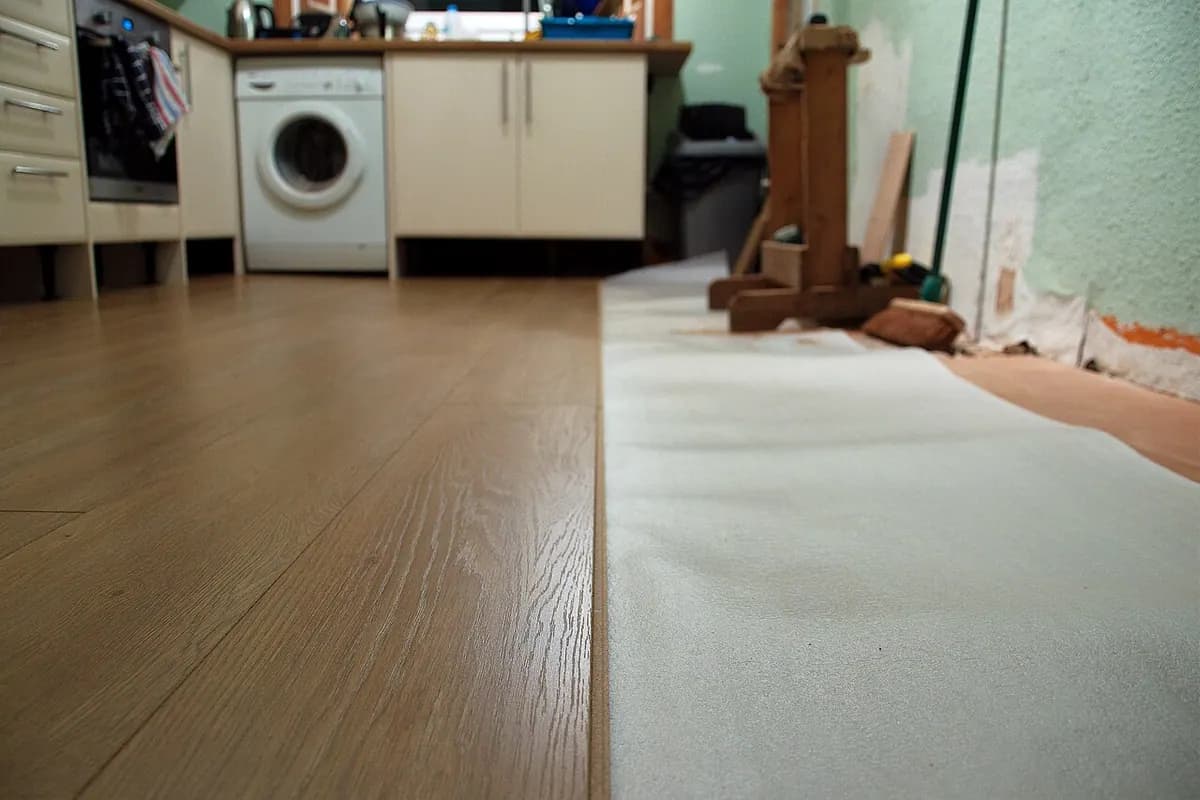
Kitchen planks
Ask if rated for kitchens and baths
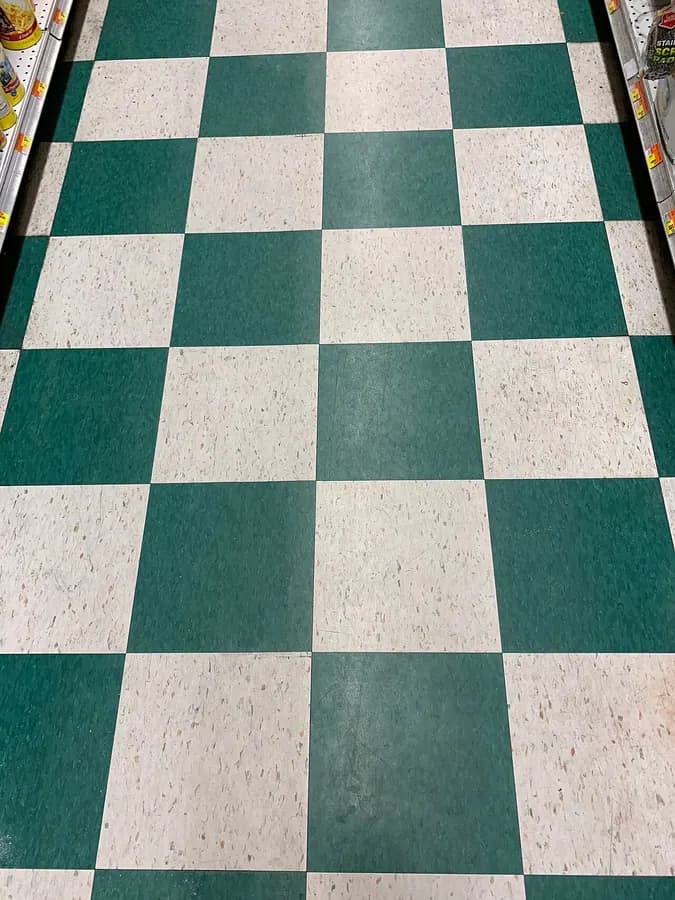
Old vinyl tile
Test for asbestos before tearing out
Red flags
4 of 11Product not named
Ask for the product, thickness and wear layer.
Subfloor and moisture skipped
This is where extras appear.
No time to acclimate
Ask what the manufacturer calls for.
Pressure to sign today
A fair quote is still fair tomorrow.
7 more red flags
Refinishing with no stain sample or finish test on your actual floor.
No written quote, or a quote that is a single total with no detail about what is included.
A large payment up front, or a request for cash only.
Some states limit how much a contractor can ask for before work starts.
A license number that does not check out.
Where your state licenses this trade, look the number up yourself on the state licensing board's site.
No proof of insurance.
Ask for a certificate sent to you directly by the insurer or the agent.
A price far below every other quote, followed by extras once the work has started.
Someone who knocks on your door uninvited, or who will not give recent local references.
Where homeowners say it goes wrong
- Got ghosted or no-showed by the last flooring guy after he promised a date
- Quotes vary wildly between contractors and they can't tell who's honest
- Project ran way over schedule and they couldn't use their kitchen/rooms for weeks
- Hidden costs appeared mid-job (subfloor repair, leveling, tear-out 'extras')
- Sloppy work — visible lippage, gaps, squeaks, or uneven seams after install
- Worried about dust and disruption from sanding/refinishing while living there
- Confused by material choices (LVP vs laminate vs engineered) and pushy upsells
Ask every flooring installer
What is my subfloor like, how will you handle leveling or repairs, and is that priced in?
Which exact product and wear layer is this, and what does the manufacturer's warranty require (acclimation, moisture limits, subfloor prep)?
How much extra material is included for waste, and what happens to leftovers I may need for future repairs?
2 more questions
Are you licensed where this work requires it, and insured? Can I see the license number and a certificate of insurance sent to me by your insurer?
What exactly does the warranty cover, for how long, and who honors it (you, the manufacturer, or both)? Will you put it in writing?
Permits
This work rarely needs a permit, although exceptions exist when it touches structure, electrical, plumbing or gas.
Flooring rarely needs a permit. Exceptions include work that involves structure, subfloor framing, plumbing or electrical, and condo or HOA buildings that have sound-insulation rules for flooring.
- Your building department decides what applies at your address. Rules differ by city and county, and HOA, condo or historic-district rules can add more.
- Ask who pulls the permit. Normally the licensed contractor does and the price includes it. If a contractor asks you to pull it in your own name, ask why: it can shift responsibility for the work to you.
- If you are unsure, call your local building department before you sign. Unpermitted work can cause problems with insurance and when you sell.
Words you'll see
Subfloor
The structural layer under the flooring. Its flatness and dryness decide how well new flooring performs.
What this trade covers
13 kinds of jobsAs the trade lists them
- Hardwood floor installation (solid and engineered)
- Hardwood sanding and refinishing (screen and recoat, full sand-and-stain)
- Luxury vinyl plank (LVP/SPC) install: click-lock floating and glue-down
- Ceramic and porcelain tile installation (floors, backsplashes, showers)
- Carpet installation, stretching, and re-stretching out ripples
- Laminate flooring installation
- Subfloor repair and leveling (self-leveling compound, plywood replacement)
- Water-damaged floor repair and board replacement
- Tile and grout repair, regrouting, and recaulking
- Floor removal and tear-out (demo of old flooring)
- Transition strips, baseboards, and trim/molding install
- Free in-home measure and estimate
- Tile shower waterproofing and rebuilds
How people describe itUrgent calls and planned ones
When it can't wait
- “A pipe burst and there's water all over my new hardwood floor”
- “My floor is buckling and the boards are popping up after a leak”
- “The dishwasher flooded and my laminate is swelling up and lifting”
- “My hardwood is cupping and the edges are curling up overnight”
- “There's water seeping under my tile and I think the subfloor is soaked”
- “The whole floor is soft and spongy when I walk on it”
- “My carpet is soaked and I'm smelling mold already”
- “A tile cracked and a chunk is sticking up — someone's going to trip and fall on it”
- “The water heater leaked and my floor is warped and lifting in the kitchen”
- “Insurance adjuster is coming and I need someone to look at the water-damaged floor today”
When it can be planned
- “I want a quote to replace my carpet with LVP”
- “How much to refinish my hardwood floors in the living room and hall?”
- “I'd like an estimate for tile in my bathroom”
- “When can someone come measure for new flooring?”
- “My carpet has some ripples I'd like stretched out”
- “I want to compare engineered hardwood vs vinyl plank for my kitchen”
- “Looking to redo my whole first floor before we list the house”
- “Can you regrout my shower tile, it's getting discolored?”
Paying for it
Before you finance anything6 basics, then the financing guide
Most home projects can be paid in cash or financed. A few basics before you sign anything:
- Ask for the cash price and the financed price in writing, for the same scope of work. They can differ, because a financing fee (sometimes called a dealer fee) may be built into the financed price.
- Compare the total you will pay over the whole loan, not just the monthly payment.
- Read the fine print on same-as-cash and zero-interest offers, especially what happens if the balance is not paid in full by the end of the promotional period.
- PACE financing is repaid through your property tax bill and can place a lien on your home. Read the terms closely, and consider asking your mortgage servicer how it is treated, before you agree.
- Utility and state programs sometimes offer low-rate loans for efficiency work. Check yours before accepting the contractor's offer.
- Take loan paperwork home and read it. A sign-it-today loan is a reason to slow down.
There is more in the financing guide.financing guide
We are not a lender and do not arrange loans. Financing information here is general education; lenders decide terms.
What an expert knows
Short notes from public sources such as federal agencies, safety groups and trade associations. Each note links to the page it came from, and every page was opened and read on 2026-10-03. This is a starting point, not a complete list of every rule or program, and it is general information, not legal, tax, engineering or insurance advice. Rules and prices vary by place, so confirm what applies at your address.
Types, pros, cons and lifespan8 notes, each with its source
- Solid wood: A solid piece of wood from top to bottom.NWFA: Real Wood definition (solid, engineered, composite engineered) (opens in a new tab)
- Engineered wood: Real wood from top to bottom, usually made of several veneers or slats glued in opposing directions.NWFA: Real Wood definition (solid, engineered, composite engineered) (opens in a new tab)
- Composite engineered, or wood-look: Real wood only on the wearable surface, with a backing and core that can be any composite material. Check what is under the top layer.NWFA: Real Wood definition (solid, engineered, composite engineered) (opens in a new tab)
- Carpet fibers: Most carpet in the U.S. uses one of five main fibers: nylon, polyester, polypropylene (olefin), triexta or wool. Each differs in durability, stain resistance, texture retention and ease of cleaning.Carpet and Rug Institute: Selecting the Right Carpet (opens in a new tab)
- Carpet styles: Cut pile gets its durability from fiber type, tuft density and yarn twist. Textured plush and frieze hide footprints and vacuum marks. Loop and cut-and-loop styles add pattern and durability.Carpet and Rug Institute: Selecting the Right Carpet (opens in a new tab)
- Carpet cushion: A firm, resilient cushion adds comfort, acoustics and insulation and extends carpet life. It can be fiber, rubber or polyurethane foams, including bonded foam sometimes called rebond.Carpet and Rug Institute: Selecting the Right Carpet (opens in a new tab)
- Laminate and other composite-core floors: Plywood, fiberboard and particleboard are commonly used in flooring, and they must meet federal formaldehyde limits and carry a compliance label.EPA: Frequent Questions for Consumers about the Formaldehyde Standards for Composite Wood Products (opens in a new tab)
- Old resilient tile and sheet floors: In older homes, floor tiles, vinyl sheet backing and the adhesives under them may contain asbestos. You cannot tell by looking.CPSC: Asbestos in the Home (opens in a new tab)
Sizing and choosing5 notes, each with its source
- Cushion thickness and density: For most residential cut pile carpet, choose cushion no thicker than 7/16 inch and no thinner than 1/4 inch, at 6 pounds density. For berber or low-profile carpet, no thicker than 3/8 inch at 8 pounds. Follow the carpet maker's requirements.Carpet and Rug Institute: Selecting the Right Carpet (opens in a new tab)
- Cushion by room: Bedrooms and light-traffic rooms can use thicker, softer cushion. Living rooms, hallways and stairs need thinner, firmer cushion.Carpet and Rug Institute: Selecting the Right Carpet (opens in a new tab)
- Concrete must be flat and dry: Under wood, a concrete slab should be flat to about an eighth of an inch over six feet, dry, tested for moisture and clean of sealers, oils and paint. High spots are flattened and low spots filled.NWFA: Wood Floor Facts, Concrete Subfloors (opens in a new tab)
- Know the conditions: Installers should know the room's conditions, the moisture of the flooring and the moisture of the base before installing wood. Acclimation lines up the flooring with the room it will live in.NWFA: Wood Flooring Installation Guidelines (opens in a new tab)
- Stiff floors for tile: The traditional minimum for a tiled floor is a deflection limit of span divided by 360. Failures have been seen even at stiffer floors, so tile makers rely on proven build-ups, not measurements alone.Tile Council of North America FAQ: Deflection (opens in a new tab)
Maintenance by season4 notes, each with its source
- Seasonal humidity: Average moisture in wood floors varies by region and by season, so wood expands and contracts through the year.NWFA: Wood Flooring Installation Guidelines (opens in a new tab)
- Grout checks: Cracked or loose grout is a signal. Common causes are a floor that flexes, grout not packed into the joint, and grout mixed with too much water or additive.Tile Council of North America FAQ: Cracked or Loose Grout (opens in a new tab)
- Older resilient floors: If you have floors that might contain asbestos, inspect them regularly for tears, abrasion or water damage.CPSC: Asbestos in the Home (opens in a new tab)
- Cleaning old floors: Do not sand, saw, sweep or vacuum material that may contain asbestos. Leave it alone if it is in good shape.CPSC: Asbestos in the Home (opens in a new tab)
Code and permit basics4 notes, each with its source
- Composite wood labels: Composite wood products and finished goods made from them must be labeled as meeting the TSCA Title VI formaldehyde standard. Laminated products fall under the same rule. Ask to see the label. This is general information, not legal advice.EPA: Frequent Questions for Consumers about the Formaldehyde Standards for Composite Wood Products (opens in a new tab)
- Asbestos handling: Contractors who handle asbestos use HEPA vacuums and wet cleanup, and must follow state and local disposal rules. Ask for proof of training.CPSC: Asbestos in the Home (opens in a new tab)
- Wet-area backing: How building codes treat drywall as a backer in showers is read differently by different people, so check with your local code official.Tile Council of North America FAQ: Showers (opens in a new tab)
- Silica dust: Grinding concrete to flatten it creates silica dust, which is regulated by OSHA. Ask how your installer controls it.NWFA: Wood Floor Facts, Concrete Subfloors (opens in a new tab)
What moves the price5 notes, each with its source
- Subfloor preparation: Flattening, filling, moisture testing and a vapor retarder are separate steps for wood over concrete. Ask how each is priced.NWFA: Wood Floor Facts, Concrete Subfloors (opens in a new tab)
- Cushion and carpet match: The wrong cushion can cause wrinkling, buckling and seam separation, and may void the carpet warranty.Carpet and Rug Institute: Selecting the Right Carpet (opens in a new tab)
- Shower waterproofing: Shower methods in the TCNA handbook rely on a waterproof membrane over a solid backing, and manufacturers do not all agree on which backers suit which membranes.Tile Council of North America FAQ: Showers (opens in a new tab)
- Asbestos in old floors: Sealing or covering damaged material is typically cheaper than removal, but removal may be needed in a major renovation.CPSC: Asbestos in the Home (opens in a new tab)
- Stiffening a flexible floor: A floor that flexes too much can crack grout and, if severe, tile, so the structure may need work before tile goes down.Tile Council of North America FAQ: Cracked or Loose Grout (opens in a new tab)
Common scams4 notes, each with its source
- Wood-look versus real wood: NWFA runs a consumer campaign to help buyers tell real wood from wood-look products. Ask exactly what the surface layer and core are made of.NWFA: Real Wood definition (solid, engineered, composite engineered) (opens in a new tab)
- Pressure to sign today: Be wary of a discount that only holds if you sign right away.FTC: How To Avoid Scams After Weather Emergencies and Natural Disasters (opens in a new tab)
- Door-knockers with leftover flooring: Uninvited workers who say they are in the area, or offer leftover material, are a common home repair scam.FTC: How To Avoid a Home Improvement Scam (opens in a new tab)
- Cash or large deposits: Do not pay the whole job up front, and avoid cash or wire payments.FTC: How To Avoid a Home Improvement Scam (opens in a new tab)
Ask for this in writing5 notes, each with its source
- Subfloor work and test results: What will be done to the subfloor, and the moisture test results for any concrete slab.NWFA: Wood Floor Facts, Concrete Subfloors (opens in a new tab)
- Cushion and carpet specifications: Thickness and density of the cushion, matched to the carpet manufacturer's requirements.Carpet and Rug Institute: Selecting the Right Carpet (opens in a new tab)
- Composite wood compliance: That composite-core products carry the formaldehyde compliance label.EPA: Frequent Questions for Consumers about the Formaldehyde Standards for Composite Wood Products (opens in a new tab)
- Older homes: asbestos plan: Whether old tile or adhesive was tested before work, and how it will be handled.CPSC: Asbestos in the Home (opens in a new tab)
- Shower method: Which waterproofing membrane and backer will be used.Tile Council of North America FAQ: Showers (opens in a new tab)
Repair or replace3 notes, each with its source
- Cracked grout: Common causes are a flexing floor, poorly packed joints and a bad grout mix, and a field inspection may be needed to tell which. Fix the cause before regrouting.Tile Council of North America FAQ: Cracked or Loose Grout (opens in a new tab)
- Damaged old tile: For floors that may contain asbestos, sealing or covering is typically cheaper than removal. Do not sand or scrape them.CPSC: Asbestos in the Home (opens in a new tab)
- Wrinkled or buckled carpet: A cushion that is wrong for the carpet can cause wrinkling and seam separation, so check the cushion as well as the carpet.Carpet and Rug Institute: Selecting the Right Carpet (opens in a new tab)
Questions to ask an expert5 notes, each with its source
- Have you moisture tested my concrete slab or wood subfloor? Ask to see the readings before wood goes down.NWFA: Wood Floor Facts, Concrete Subfloors (opens in a new tab)
- How will you handle a floor that is not flat? Ask how high and low spots are corrected.NWFA: Wood Floor Facts, Concrete Subfloors (opens in a new tab)
- Is my older floor likely to contain asbestos? Ask for testing before anything is removed.CPSC: Asbestos in the Home (opens in a new tab)
- Which cushion fits this carpet? Ask for thickness and density.Carpet and Rug Institute: Selecting the Right Carpet (opens in a new tab)
- How will the shower be waterproofed? Ask which membrane and backer.Tile Council of North America FAQ: Showers (opens in a new tab)
General information, not legal, tax, engineering or insurance advice. Photos credited with their licenses; drawings made for this site. Guide updated October 3, 2026.